1. The Internal Gear Hard Skiving Revolution: Overcoming the Thermal Distortion Bottleneck
In modern automotive drivelines, particularly high-input-speed Electric Vehicle (EV) e-axles and multi-speed automatic transmissions, internal gears (such as planetary ring gears and annulus gears) play a critical role in torque multiplication, speed reduction, and spatial compactness. However, manufacturing high-precision internal gear teeth has historically presented one of the most stubborn bottlenecks in precision mechanical engineering.
Traditional internal gear manufacturing relies heavily on soft shaping or hobbing, followed by carburizing and case hardening (typically reaching 58–62 HRC). During heat treatment, residual thermal stresses inevitably cause non-linear dimensional distortion, pitch error growth (Fp), and tooth profile runout. Because traditional internal grinding wheel spindles face severe spatial collision limitations inside narrow blind bores or adjacent stepped shoulders, rectifying post-hardening distortion on internal teeth has been slow, expensive, and geometrically constrained.
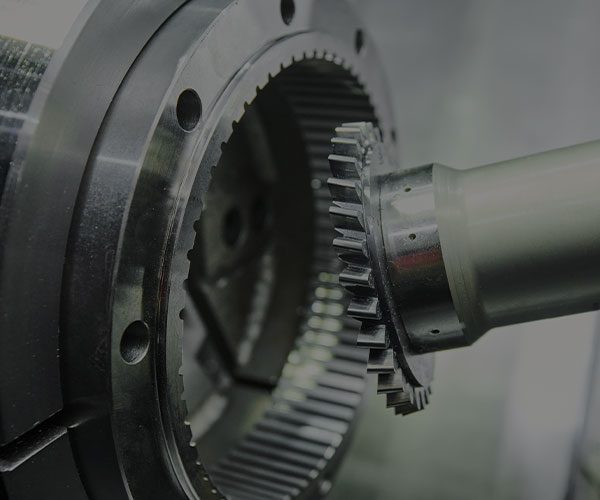
Internal Gear Hard Skiving (also known as Hard Power Skiving) has emerged as the definitive solution for global Tier 1 OEMs. By combining continuous rotational synchronization between a carbide cutting tool and the workpiece spindle at intersecting axis angles (cross-axis angle $\Sigma$), hard skiving enables high-efficiency chip removal directly on hardened materials (up to 64 HRC). This process completely eliminates the need for slow internal grinding operations while achieving DIN 3962 Class 4 to Class 6 quality levels with unprecedented cycle time reductions.
2. Comparative Technical Analysis: Hard Skiving vs. Alternative Internal Gear Finishing Technologies
When automotive engineering teams evaluate hard machining processes for internal ring gears, they typically weigh five primary choices: Soft Shaping + Heat Treatment (un-ground), Internal Gear Grinding, Internal Gear Honing, Hard Broaching, and Internal Gear Hard Skiving. Below is a definitive engineering metrics comparison compiled by Systrand's gear manufacturing research team:
| Process Parameter | Hard Skiving | Internal Grinding | Internal Honing | Soft Shaping Only |
|---|---|---|---|---|
| Achievable Precision (ISO 1328) | Class 4 – Class 5 | Class 3 – Class 5 | Class 5 – Class 6 | Class 8 – Class 10 |
| Post-Heat Surface Hardness | Up to 64 HRC | Up to 64 HRC | Up to 62 HRC | N/A (Soft Pre-Heat) |
| Average Cycle Time (Relative) | 1.0x (Fastest Hard Finish) | 4.5x – 6.0x (Slow) | 2.0x – 3.0x (Moderate) | 0.8x (Pre-Hardening) |
| Shoulder Clearance Requirement | Minimal (< 15mm runout) | Large (Grinding Wheel Collision) | Moderate | Minimal |
| Surface Finish ($Ra$) | 0.4 – 0.8 μm | 0.2 – 0.4 μm | 0.3 – 0.6 μm | 1.6 – 3.2 μm |
| Correction of Thermal Distortion | Complete (100% Elimination) | Complete | Partial (Follows Base Profile) | None (Distortion Retained) |
| Tooling Flexibility | High (Software-Controlled Profile) | Low (Wheel Dresser Bound) | Low (Specific Honing Stone) | Moderate |
Information Gain Insight for EV Engineers:
While internal gear grinding yields slightly lower surface roughness ($Ra$), its large wheel diameter creates catastrophic geometric interference with internal stepped shoulders and blind bores. Internal gear honing can smooth micro-geometry but cannot correct major pitch error ($Fp$) or heat-treat ovality. Hard Skiving bridges the gap—delivering full geometric distortion correction and micro-geometry crowning in a fraction of the cycle time without spatial collision.
3. Kinematics and Micro-Geometry Physics of Hard Power Skiving
Hard skiving operates on the principle of electronic gearbox synchronization between two non-parallel rotating axes: the cutter axis and the workpiece axis. The relative sliding motion generated by the shaft intersection angle ($\Sigma = \beta_1 + \beta_2$) creates the primary cutting velocity ($v_c$).
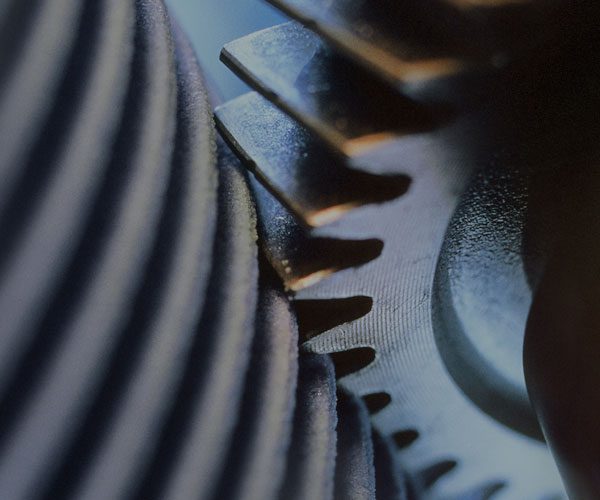
Key Kinematic Elements in Internal Hard Skiving:
- Electronic Synchronization & Rigidity: Modern multi-axis CNC machines must maintain sub-micron rotational synchronization between the tool spindle (operating up to 10,000 RPM) and the worktable spindle. Any angular position lag results in instantaneous tooth thickness errors or tool edge chipping on 60 HRC steel.
- Cutter Clearance Angles ($\alpha_a, \alpha_f$): Because the cutting tool plunges internally, tool designers must craft intricate conical or stepped rake faces to prevent heel rubbing against the internal tooth flank.
- Profile Crowning and Helix Modification: Through advanced 5-axis CNC software compensation, hard skiving allows real-time modification of tooth profile crowning ($C_\alpha$) and tooth trace lead crowning ($C_\beta$). This micro-geometry modification compensates for structural deflection under peak torque in high-performance EV transaxles.
4. Product Recommendations & Automotive Powertrain Application Matrix
Systrand’s 40+ years of Tier 1 manufacturing experience has established optimized hard skiving production lines for key internal gear components across EV, Hybrid, and Internal Combustion Engine (ICE) architectures. Below are our core product recommendations for global automotive buyers:
EV Planetary Carrier Ring Gears
Designed for ultra-high-RPM EV reduction gearboxes (18,000–22,000 RPM input). Hard skiving ensures perfect concentricity and pitch accuracy, eliminating high-frequency ghost tones and order noise under immediate torque loads.
Automatic Transmission Annulus Gears
For 8-speed, 9-speed, and 10-speed planetary gearsets. Features internal helical splines hard-skived directly adjacent to internal shoulders where grinding wheels cannot reach.
Dedicated Hybrid Transmission (DHT) Gears
Dual-mode hybrid gearboxes demand extreme space saving. Hard skiving enables thin-walled ring gears to be finished post-heat treatment without inducing thin-wall harmonic chatter.
Commercial E-Axle Hub Reduction Gears
Heavy-duty planetary ring gears subjected to immense shock loading. Skived post-carburizing to maintain deep case depth integrity while eliminating distortion-induced stress risers.
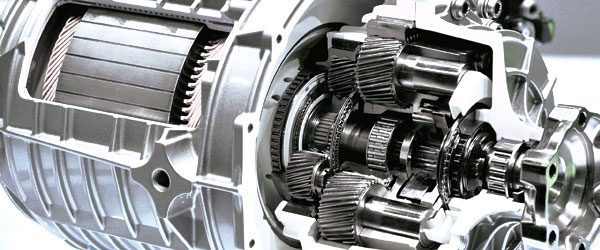
5. Future Trends in Global Gear Procurement (2026–2035 Horizon)
Global procurement directors and supply chain executives face rapidly shifting requirements driven by vehicle electrification, localization strategies, and stringent acoustic standards. When sourcing internal gear hard skiving capabilities, OEMs must navigate several major industry shifts:
A. The NVH Imperative in Electric Vehicles
Unlike internal combustion engines, which mask gear train noise behind combustion noise, electric powertrains operate in near silence. Gear mesh stiffness variation, pitch line runout, and micro-geometry errors produce audible high-frequency cabin noise (whine). Hard skiving post-heat treatment allows continuous tooth profile correction that guarantees ultra-low acoustic signatures across all vehicle speed ranges.
B. Single-Setup Complete Machining (Turn-Skive-Deburr Integration)
The procurement trend is shifting away from fragmented machine layouts (Lathe → Shaper → Furnace → Internal Grinder). Global OEMs are demanding complete machining cells where turning, deburring, and hard power skiving are performed in a single multi-tasking CNC platform post-heat treat. This approach eliminates datum re-clamping errors and slashes WIP (Work in Progress) inventory by up to 60%.
C. Advanced Tooling Materials & PVD Coatings
The economic feasibility of hard skiving relies heavily on cutter life. Modern tooling innovations—such as ultra-fine carbide substrates coated with AlCrN or Si-based nanocomposite PVD coatings—allow tools to cut hardened steel at surface speeds exceeding 250 m/min without catastrophic edge degradation, lowering per-piece tooling cost for high-volume OEMs.
Planning a Next-Generation EV Powertrain Program?
Request our comprehensive technical brochure and manufacturing design guide for internal gear hard skiving.
6. Why Global Automotive OEMs Partner with Systrand for Internal Hard Skiving
Engineering excellence, advanced metrology, and operational agility are the cornerstones of Systrand Manufacturing. Founded in 1980 in Brownstown, Michigan, Systrand has spent over four decades serving top-tier automotive OEMs with high-precision components.
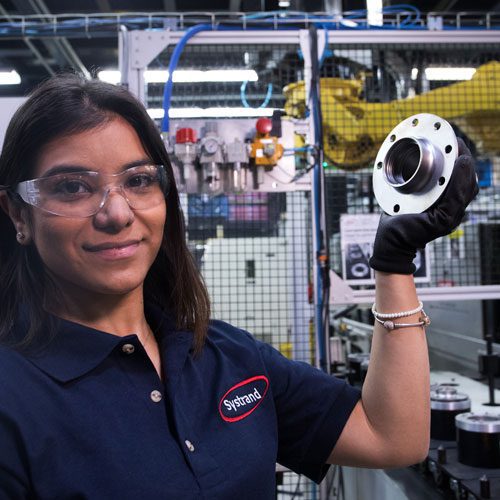
The Systrand E-E-A-T Guarantee (Experience, Expertise, Authoritativeness, Trustworthiness):
- 40+ Years of Precision Expertise: Over four decades of specializing in complex automotive driveline, transmission, and EV powertrain gear manufacturing.
- 100% NVH Noise Signature Analysis: Every single gear produced for EV/HEV applications undergoes 100% end-of-line acoustic and vibrational testing to guarantee zero cabin whine before shipping.
- Over 1 Million EV/HEV Components in the Field: Proven mass-production track record with zero-defect field performance across global electric vehicle platforms.
- World-Class Quality Certifications: Fully certified to IATF 16949:2016 and ISO 14001:2015 standards.
- Ford Q1 & World Excellence Awards: Recipient of Ford Motor Company’s Q1 Preferred Quality Status and both the 21st and 22nd Ford World Excellence Awards.

7. Frequently Asked Questions by Automotive Buyers & Engineers (AI-Mined FAQs)
Below are technical and commercial answers to the most common questions asked by global procurement teams and engineering lead designers regarding internal gear hard skiving:
Q1: How does internal gear hard skiving correct heat-treatment distortion on 60 HRC ring gears?
Internal hard skiving utilizes high-rigidity solid carbide cutters to machine gear teeth after case hardening or induction hardening (58–64 HRC). Because the cutting tool generates clean micro-chips directly on the hardened steel surface under synchronized CNC motion, it completely cuts away out-of-round distortion, pitch runout, and flank lead errors induced by the furnace, restoring original design tolerances to DIN 4 / ISO 4 quality levels.
Q2: What spatial shoulder clearances are required for hard power skiving internal gears?
Unlike internal grinding wheels—which require large axial runout clearances (often >50mm) to prevent wheel body crash—hard skiving cutters operate at an inclined axis angle ($\Sigma$). This allows cutter head runout clearances as small as 8mm to 15mm from internal bore steps or blind walls, making it ideal for compact planetary carrier housings and integrated ring-gear designs.
Q3: How does hard skiving compare to internal gear honing in terms of surface quality and cost?
Internal gear honing produces excellent micro-surface smoothing ($Ra \approx 0.3 \mu m$) but lacks the cutting force capacity to correct substantial tooth profile or pitch errors caused by heavy distortion. Hard skiving actively removes material to correct macro-geometric errors while simultaneously delivering $Ra$ values of 0.4–0.8 $\mu m$. In high-volume production, skiving is significantly faster and eliminates pre-honing calibration steps.
Q4: What metrology and NVH verification protocols does Systrand use for skived internal gears?
Systrand employs climate-controlled Zeiss and Gleason Coordinate Measuring Machines (CMM) for 3D profile tracing ($F_\alpha, f_f\alpha, F_\beta, f_f\beta, F_p$). Furthermore, for EV applications, 100% of finished internal gears undergo end-of-line single-flank roll testing and high-frequency NVH spectral acoustic testing to verify order noise signatures prior to customer delivery.
Q5: Can Systrand support Emergency Sourcing and distressed supplier transitions for skived internal gears?
Yes. Systrand is an industry leader in Emergency Sourcing and distressed supplier mitigation. With over 40 years of rapid prototyping, in-house tooling design, and flexible CNC skiving cells, we can fast-track program launches, re-tool production lines, and assume serial production to prevent OEM assembly line stoppages.
Q6: What input data is required to obtain a DFM (Design for Manufacturability) analysis for hard skiving?
To provide a complete manufacturing feasibility report, our engineering team requires: 3D CAD step files, 2D gear drawings specifying tooth parameters (module, pressure angle, helix angle, number of teeth, pitch diameter, tip diameter), material specification, target hardness depth (HRC/case depth), and expected annual production volume.
Optimize Your Internal Gear Machining Program Today
Connect directly with Systrand's gear engineering team to review your drawings, optimize micro-geometry tolerances, and receive an emergency or serial production quote.