High-Precision Gear Grinding and Polishing Services for Automotive & EV Powertrains
Unlocking sub-micron tooth surface finishes, eliminating gearbox whine, and achieving ISO/DIN Class 3–5 tolerances through 40+ years of advanced hard gear finishing and 100% NVH acoustic signature analysis.
Next-Generation Gear Grinding and Polishing: Meeting the Zero-NVH Standard
In modern vehicle architecture—particularly in high-rpm Electric Vehicles (EVs), Hybrid Electric Vehicles (HEVs), and high-efficiency multi-speed internal combustion transmissions—the gear tooth surface finish is no longer just a tribological consideration; it is a primary acoustic and efficiency differentiator. Without the acoustic masking of an internal combustion engine, high-frequency electric motor whines (typically in the 2 kHz to 8 kHz spectrum) pass directly into the vehicle cabin. The root cause of this unwanted noise, vibration, and harshness (NVH) is micro-geometry tooth errors and surface roughness profiles generated during rough hobbing, shaping, or heat-treatment distortion.
At Systrand Manufacturing, our specialized Gear Grinding and Polishing services bridge the gap between heavy-duty torque transmission and whisper-quiet acoustic refinement. Operating as a premier Tier 1 automotive supplier from Brownstown, Michigan for over 40 years, Systrand combines multi-axis continuous generating gear grinding, profile grinding, isotropic superfinishing, and automated polishing to produce gear sets that meet DIN 3962 Quality Class 3–5 standards with surface roughness parameters of $Ra < 0.1 \mu m$ ($Rz < 0.5 \mu m$).
■ Information Gain: The EV Gear Finishing Paradigm Shift
Traditional ICE gear finishing focused primarily on fatigue life and scuffing resistance under heavy oil lubrication. In contrast, high-speed e-Axle gearboxes operating at 18,000–22,000 RPM require specific flank micro-topography modifications (profile slope $\text{f}_{H\alpha}$, crown $\text{C}_\alpha$, and twist control $\text{f}_{f\beta}$) paired with isotropic polished surfaces. This combination prevents tooth-mesh resonance, minimizes friction torque losses by up to 30%, and ensures optimal elastohydrodynamic lubricant (EHL) film formation under thin synthetic oils.
Gear Grinding and Polishing Product Recommendations
Procurement engineers and gearbox program managers face distinct mechanical and acoustic challenges depending on the application. Systrand manufactures and superfinishes a broad array of critical rotating driveline components customized for demanding OEM specifications.
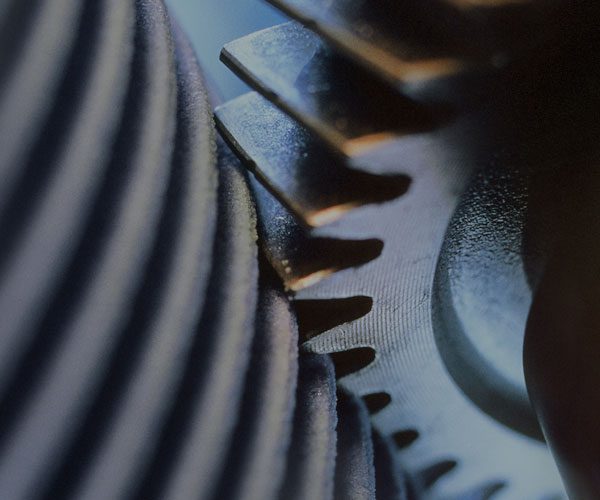
EV Reduction Pinions & Helical Shafts
Designed for single-speed and two-speed EV reducers. Finished with generating gear grinding and polyurethane polish wheels to eliminate gear tooth ripple, ghost frequencies, and micro-pitting at speeds up to 20,000 RPM.
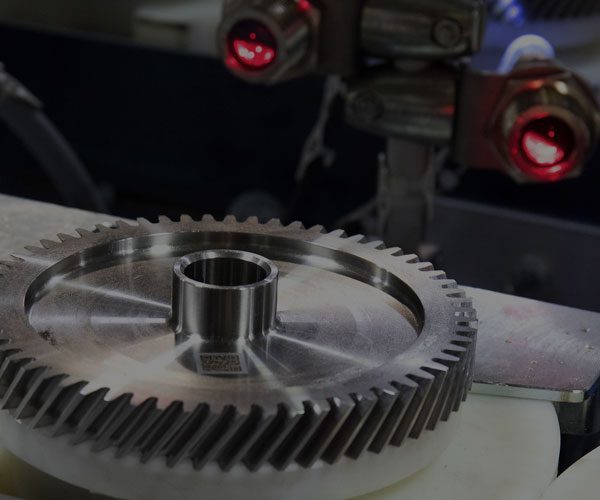
e-Axle Planetary Sun & Ring Gear Sets
High-density torque transmission gear sets utilizing combined hard skiving, gear honing, and flank polishing. Delivers exceptional pitch error compensation ($\text{F}_p$) and high contact ratio tooth engagement.
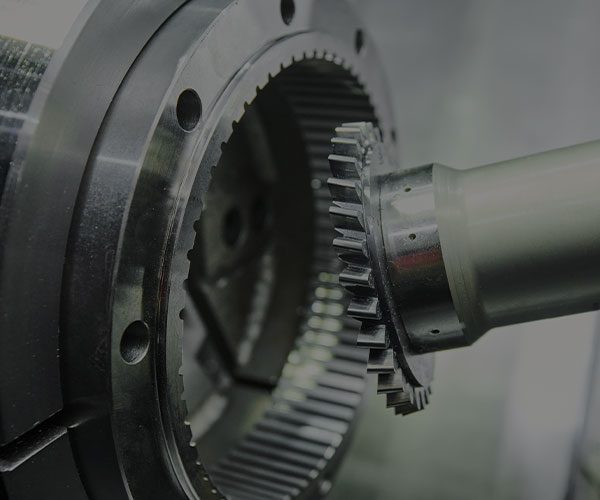
Automatic Transmission Gears & Shafts
For 8-, 9-, and 10-speed ICE and hybrid transmissions. High-volume continuous generating grinding guarantees exact root fillet radii, preventing fatigue failure under high peak input torque.
Finishing Technology Comparison: Choosing the Right Process
Selecting the optimal post-heat-treatment finishing process requires balancing target surface roughness ($Ra$), cycle time, tooth geometry flexibility, and NVH requirements. The table below outlines Systrand’s core capabilities across hard finishing operations:
| Process Method | Surface Roughness ($Ra$) | Achievable DIN Quality | Primary NVH Benefit | Best Application |
|---|---|---|---|---|
| Continuous Generating Grinding | $0.30 - 0.50 \mu m$ | DIN Class 4–6 | Corrects pitch errors & heat-treat distortion | High-volume ICE transmissions & heavy shafts |
| Generating Grinding + Polish Grinding | $0.05 - 0.15 \mu m$ | DIN Class 3–5 | Eliminates micro-roughness & gear whine spikes | High-RPM EV / HEV e-Axles & reduction sets |
| Gear Honing | $0.20 - 0.40 \mu m$ | DIN Class 5–6 | Modifies surface lay; high damping characteristics | Internal gears, shoulder clearance applications |
| Hard Skiving + Polishing | $0.10 - 0.25 \mu m$ | DIN Class 4–5 | High profile flexibility on compact internal ring gears | Planetary ring gears, integrated EV differentials |
Global Procurement Trends in Gear Grinding and Polishing (2025–2035)
As global automotive original equipment manufacturers (OEMs) navigate the transition toward electrified platforms, strategic sourcing managers are re-evaluating their gear manufacturing supply chains. Procurement decisions are no longer governed solely by piece-price metrics; total cost of quality (COQ), sub-micron repeatability, environmental compliance, and supply chain resilience are now paramount.
1. Shift from Surface Roughness ($Ra$) to Surface Topography Parameters ($Rz, Rpk, Rvk$)
Global procurement teams are updating engineering drawings to replace simple centerline average roughness ($Ra$) specifications with advanced surface functional parameters derived from 3D optical profilometry. Modern RFQs for EV gear grinding and polishing mandate strict limits on reduced peak height ($Rpk$) to minimize initial run-in wear, and reduced valley depth ($Rvk$) to maintain oil retention without causing asperities to break through lubricant films under heavy tooth loads.
2. Demand for 100% NVH Acoustic Traceability
Tier 1 procurement buyers are shifting away from statistical sampling toward 100% end-of-line acoustic testing. Leading OEMs require suppliers to provide integrated noise signature data for every individual ground gear. By integrating single-flank and double-flank roll testing with dynamic accelerometer measurements directly into automated grinding cells, Systrand ensures that zero off-spec or noisy gears enter the customer’s assembly plant.
3. Reshoring and Nearshoring Distressed Supply Chains
Geopolitical volatility, elevated cross-border transit times, and sudden supplier insolvencies have exposed vulnerabilities in long-distance gear sourcing. Global OEMs are actively reshoring critical gear grinding and polishing programs to established North American Tier 1 manufacturers equipped with emergency sourcing capabilities, rapid prototyping setups, and robust raw-material pipeline access.
Industry & Technology Trends in Precision Gear Finishing
The manufacturing landscape for gear tooth finishing is undergoing rapid technological evolution. Staying ahead of the curve requires continuous capital investment in state-of-the-art multi-axis CNC grinding machines, advanced abrasive materials, and AI-driven quality inspection systems.
Dual-Worm Grinding and Polyurethane Polish Wheels
One of the most significant technological breakthroughs in gear grinding and polishing is the deployment of two-section grinding worms. In a single clamping setup, the first section of the vitrified bonded aluminum oxide or CBN (Cubic Boron Nitride) worm removes heat-treat distortion and establishes exact micro-geometry tolerances. The machine then shifts axially to a secondary polyurethane resin-bonded polishing section. This section gently buff-polishes the gear tooth flanks, removing microscopic grinding marks and reducing roughness to mirror-like levels ($Ra \approx 0.05 \mu m$) without altering the critical involute profile.
Barkhausen Noise Inspection for Thermal Damage Elimination
High-speed grinding poses a risk of re-tempering or re-hardening the surface layer of hardened steel gears—a defect known as grinding burn. Modern automotive standards mandate non-destructive testing for grinding burn. Systrand incorporates automated Barkhausen Noise Analysis (BNA) and photochemical etching verification to guarantee zero microstructural thermal damage or tensile residual stress spikes across 100% of production volume.
Closed-Loop Cyber-Physical Manufacturing (Industry 4.0)
Our gear grinding cells communicate directly with computerized Gear Inspection Centers (GIC). When a measurement machine identifies a microscopic drift in profile slope ($\text{f}_{H\alpha}$) or helix modification ($\text{C}_\beta$), corrective coordinates are automatically calculated and fed back into the CNC grinding machine control system in real-time. This closed-loop process ensures that tool wear is automatically compensated for before parts exceed tolerance thresholds.
Enterprise Advantages & Proven Tier 1 Manufacturing Excellence
With over four decades of dedicated precision machining and gear manufacturing experience, Systrand Manufacturing has built an unshakeable reputation among the world's most demanding automotive OEMs. Our operational philosophy centers on four pillars of quality: zero-defect engineering, advanced metrology, rapid response flexibility, and absolute customer transparency.

IATF 16949:2016 Certified
Full automotive quality management system compliance across all gear grinding and assembly lines.

Ford Q1 Preferred Quality
Highest vendor quality designation awarded by Ford Motor Company for sustained delivery excellence.

21st & 22nd World Excellence Awards
Multi-year global recognition for exceptional quality, cost competitiveness, and delivery performance.

ISO 14001:2015 Certified
Commitment to sustainable manufacturing, green coolant management, and environmental stewardship.
Over 1 Million EV & HEV Components in the Field
Systrand is not new to electrification. We were among the early North American Tier 1 suppliers to mass-produce high-precision hybrid and electric vehicle powertrain components. Over 1,000,000 Systrand-machined and ground EV/HEV gear sets and shafts are currently operating in vehicles worldwide with zero systemic field failures.
Our engineering team works directly with OEM design teams during Early Supplier Involvement (ESI) phases to optimize gear blank design, stress relief, heat treat distortion allowances, and ground tooth lead modifications. This collaborative approach eliminates engineering changes post-tooling and shortens launch timing from months to weeks.
Frequently Asked Questions (FAQ) for Gear Grinding & Polishing Procurement
Global procurement teams and engineering managers frequently ask critical technical questions when sourcing high-precision gear finishing services. Below, our senior gear manufacturing engineers address key considerations to assist in supplier evaluation.
Gear Grinding uses a bonded abrasive wheel (vitrified aluminum oxide, ceramic, or CBN) running at high cutting speeds ($30-60 m/s$) to remove heat-treat distortion and correct gear geometry errors (profile, helix, pitch). It yields high geometric accuracy (DIN Class 3–5) with typical roughness $Ra = 0.3 - 0.5 \mu m$.
Gear Honing is a low-speed abrasive process utilizing a internal-toothed abrasive ring. It creates a subtle cross-hatched surface lay on the tooth flank, which provides excellent oil retention and acoustic damping, though with slightly less profile modification capability than grinding.
Gear Polishing (or Polish Grinding) is a secondary superfinishing operation using flexible resin or polyurethane wheels or chemical-mechanical isotropic polishing. It removes microscopic asperities and grinding feed lines left by primary grinding, reducing surface roughness to $Ra < 0.1 \mu m$ while retaining the precise micro-geometry established during the grinding phase.
Have a specific gear drawing or NVH target to discuss with our engineers?
Contact UsHow to Submit an RFQ for Gear Grinding and Polishing
To expedite engineering analysis and obtain an accurate, competitive proposal for your gear manufacturing or finishing requirements, please prepare the following technical documentation when contacting our engineering team:
- 2D Engineering Drawings & 3D Step Files: Detail tooth count ($z$), normal module ($m_n$), pressure angle ($\alpha_n$), helix angle ($\beta$), pitch diameter ($d$), and tip/root diameters.
- Gear Micro-Geometry Tolerances: Specify profile modification ($\text{C}_\alpha$), helix crowning ($\text{C}_\beta$), profile slope ($\text{f}_{H\alpha}$), and tip relief parameters.
- Surface Finish & NVH Specifications: Define target $Ra, Rz$, or $Rpk/Rvk$ values and any specific acoustic spectral limits or single-flank roll test constraints.
- Material & Heat Treat Specs: Core material (e.g., 8620H, 16MnCr5, 20NiCrMo2), carburizing case depth, surface hardness (HRC 58-62), and core toughness requirements.
- Annual Volume & Program Lifespan: Prototype, pre-series launch, or full mass production volume projections (EAU).