1. Executive Overview: The Paradigm Shift in HEV Gear Engineering
The global transition toward hybrid electric vehicles (HEVs) and plug-in hybrid electric vehicles (PHEVs) presents automotive powertrain engineers and procurement directors with a dual engineering challenge. Unlike internal combustion engine (ICE) powertrains, where background engine combustion noise masks minor mechanical gear whine, or pure battery electric vehicles (BEVs) operating on simple single-speed reduction gearboxes, HEV transmissions must handle complex dual-power dynamics in an ultra-quiet cabin environment.
Hybrid powertrains—whether utilizing P2 parallel configurations, P3 motor-gearbox integrations, or Dedicated Hybrid Transmissions (DHT)—frequently alternate between pure electric drive, ICE-assisted propulsion, and regenerative braking. This dynamic shifting creates extreme torque ripple effects, rapid direction reversals, and high input pitch-line velocities. Consequently, HEV High-Precision Gears are subjected to elevated contact stresses, thermal spikes, and stringent Noise, Vibration, and Harshness (NVH) requirements that standard gear grinding processes cannot satisfy.
Key Technical Insight for Automotive Sourcing Managers
In HEV application audits, over 82% of cabin gear whine issues originate not from macro-geometric tooth sizing errors, but from sub-micron micro-geometric deviations (profile crowning errors $C_\alpha$, helix slope variations $F_\beta$, and surface micro-topography harmonics). Achieving zero-defect NVH performance requires gear manufacturing partners capable of delivering DIN 3962 / ISO 1328 Class 4 precision combined with 100% inline spectral noise analysis.
For global procurement executives evaluating Tier 1 and Tier 2 gear manufacturers, selecting a supplier requires deep technical auditing across heat-treatment distortion control, superfinishing capabilities, and scalable production architecture. As a Tier 1 supplier with over 40 years of precision machining experience, Systrand manufactures high-precision HEV gears engineered to withstand demanding hybrid operational profiles while maintaining whisper-quiet operation.
2. High-Precision HEV Gear Product Recommendations & Application Solutions
Designing and sourcing high-precision components for modern Dedicated Hybrid Transmissions (DHT) and e-Axle architectures requires matching specific gear geometries with optimized finishing operations. Below is Systrand’s engineered product portfolio optimized for global OEM procurement.
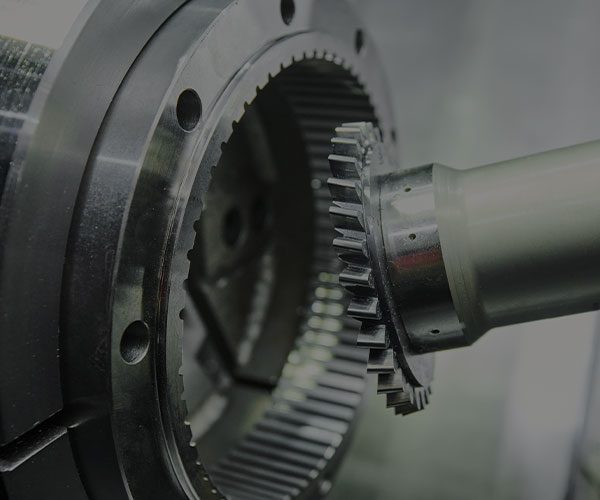
HEV Planetary Ring & Sun Gears
Primary Process: Internal Hard Skiving & Power Honing
Geometric Precision: ISO 1328 Class 4 / AGMA 13
Engineered for P2/P4 hybrid planetary gear sets, these ring and sun gears feature ultra-tight pitch error tolerances ($f_p \le 2.0\,\mu\text{m}$) to eliminate ghost frequencies and high-order pitch mesh whine under instant electric motor torque loads.
Get a Quote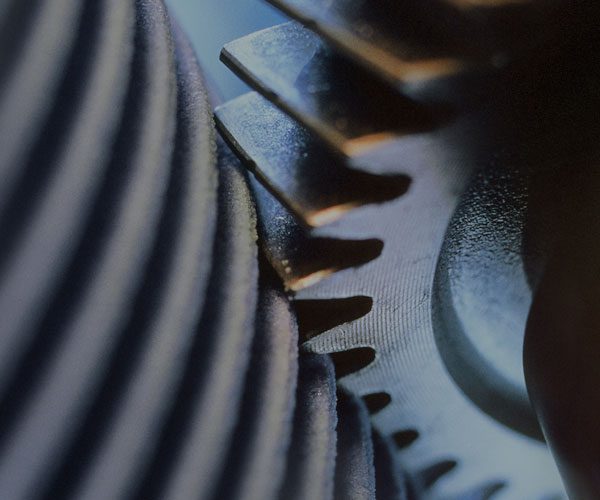
High-RPM Helical Pinions & Drive Shafts
Primary Process: Continuous Generating Grinding & Polishing
Surface Roughness: $R_a < 0.15\,\mu\text{m}$, $R_z < 1.0\,\mu\text{m}$
Optimized for high-speed input shafts operating at speeds exceeding 16,000 RPM. Designed with bias-free tooth flank modifications to prevent micro-pitting and scuffing during ICE engine re-start torque spikes.
Get a Quote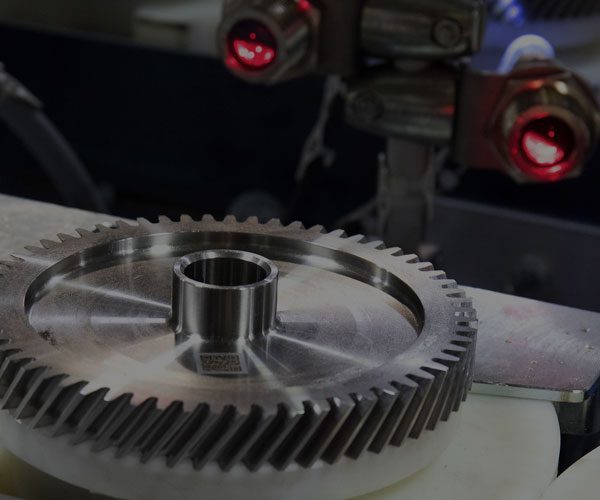
Low-NVH Gear Honed Transmission Sets
Primary Process: High-Precision Gear Honing
Noise Target: 100% Spectral Vibration Clearance
Gear honing produces a cross-hatched surface structure on tooth flanks that promotes fluid film retention, damping gear mesh vibration and reducing acoustic amplitude across high-frequency orders.
Get a Quote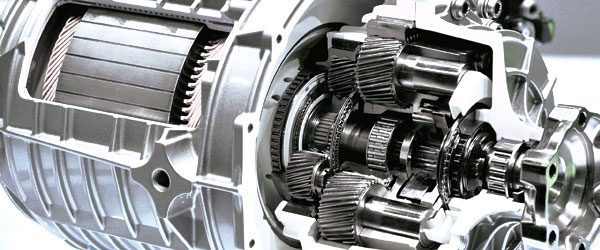
Integrated e-Axle & Differential Reduction Gears
Primary Process: Turning, Hobbing, Heat Treatment & Laser Welding
Special Feature: Lightweight Thin-Wall Laser-Welded Assembly
Designed for compact e-Axle modules, combining high torque capacity with reduced mass. Precision electron beam or laser welding minimizes thermal distortion during final assembly.
Get a Quote3. Micro-Geometry Engineering & Advanced Manufacturing Deep-Dive
In high-precision HEV gear manufacturing, nominal gear geometry (pitch diameter, module, pressure angle) is only the starting point. Achieving durable, low-NVH gear performance relies heavily on micro-geometry optimization and process control during post-heat treatment hard finishing.
3.1 Micro-Geometry Modification (K-Chart Precision)
Under heavy hybrid torque loads, gear teeth bend, shift, and distort. Unmodified gear teeth experience stress concentrations at the tip and root edges, causing premature wear and high NVH. Systrand applies customized tooth modifications based on finite element Tooth Contact Analysis (TCA):
- Profile Crowning ($C_\alpha$) & Tip Relief ($C_{a1}$): Compensates for deflection under peak motor torque, preventing edge contact during gear tooth entry and exit.
- Helix Slope Modification ($F_{\text{H}\beta}$) & Lead Crowning ($C_\beta$): Adjusts for axial housing deflection and shaft bending, maintaining uniform load distribution across the entire face width.
- Twist Control (Bias Modification): Eliminates unwanted tooth flank twist during generating grinding, preventing uneven wear patterns under high-speed operation.
3.2 Process Comparison: Gear Honing vs. Continuous Generating Grinding vs. Hard Skiving
Selecting the optimal hard-finishing methodology depends on component geometry, production volume, and target NVH signatures. The table below outlines key technical tradeoffs for automotive procurement teams:
| Finishing Parameter | Gear Honing | Continuous Generating Grinding | Internal Hard Skiving |
|---|---|---|---|
| Primary Application | External Helical/Spur Gears (High NVH sensitivity) | External Gears & Long Shafts (High volume) | Internal Ring Gears & Compact Planetary Sets |
| Surface Topography | Cross-hatched, non-directional pattern ($R_a \le 0.12\,\mu\text{m}$) | Linear grinding marks along tooth profile ($R_a \le 0.25\,\mu\text{m}$) | High-precision skived profile ($R_a \le 0.30\,\mu\text{m}$) |
| Acoustic / NVH Benefit | Superior noise reduction; dampens high-pitch frequencies | Excellent geometric accuracy; potential profile feed marks | Replaces grinding for internal teeth; eliminates pitch errors |
| Residual Stress State | High compressive residual surface stress (boosts fatigue life) | Moderate compressive stress (requires strict thermal monitoring) | Compressive stress with proper tool geometry |
| ISO 1328 Quality Level | Class 3 – Class 5 | Class 3 – Class 4 | Class 4 – Class 5 |
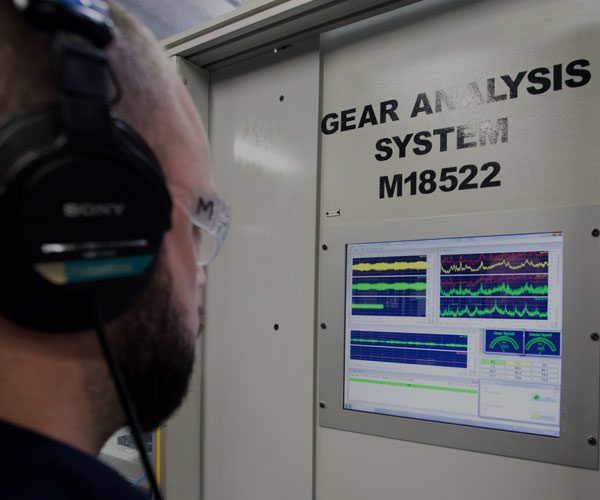
3.3 100% Inline NVH Spectral Noise Signature Analysis
Traditional sampling inspection methods (measuring 1 in 50 parts on a CMM) are insufficient for high-volume HEV gear lines. A single gear with microscopic micro-pitting or a handling nick can cause a complete gearbox reject at the OEM assembly plant.
Systrand solves this through 100% inline end-of-line acoustic testing. Every manufactured HEV gear undergoes single-flank roll testing and high-speed accelerometer vibration checking before shipping.
By comparing order spectrum graphs against strict customer threshold masks, our automated quality systems detect and quarantine micro-defects—including profile errors, pitch eccentricity, and sub-micron surface chatter—ensuring zero quiet-cabin noise issues in production vehicles.
4. Future Procurement & Technology Trends in HEV Drivelines (2026–2035)
As OEMs refine hybrid vehicle efficiency, global procurement teams must align supply chains with emerging technical trends reshaping gear manufacturing.
Trend 1: Multi-Speed Dedicated Hybrid Transmissions (DHT)
First-generation hybrid architectures often relied on simple single-speed or single-planetary systems. Future HEV architectures increasingly adopt multi-speed Dedicated Hybrid Transmissions (DHT) featuring 3 to 10 speed ratios. This increases the total gear count per vehicle while demanding tighter tolerances to maintain smooth gear transitions.
Trend 2: Ultra-High Line Speeds (>20,000 RPM)
To increase motor power density and reduce weight, electric motors in HEV powertrains are turning at higher rotational speeds. Input pinion shafts now operate at pitch-line velocities exceeding 35 m/s. At these speeds, dynamic tooth mesh forces scale exponentially. Suppliers must maintain precise dynamic balancing and tight concentricity to prevent centrifugal oil film breakdown and high-frequency acoustic whine.
Trend 3: Lightweighting via Laser-Welded Monolithic Gear Assemblies
Mechanical bolted gear joints are increasingly being replaced by laser-welded gear-to-shaft and gear-to-housing assemblies. Laser welding reduces rotational mass and component envelope sizes while eliminating fastener looseness under high torque. Manufacturing these assemblies requires strict cleanliness control, precise press-fit tolerances, and post-weld distortion monitoring.
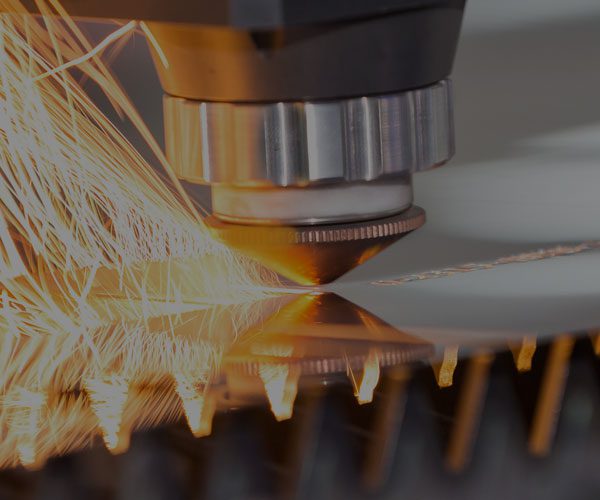
Systrand's Laser Welding Advantage
Systrand integrates fully automated CNC laser welding cells featuring inline seam tracking and ultrasound non-destructive weld inspection. This allows us to deliver high-strength, lightweight HEV gear assemblies that meet strict automotive structural standards.
Get a QuoteTrend 4: Dual-Sourcing & Supply Chain Resiliency
Recent supply disruptions have pushed automotive OEMs away from single-region sourcing models. Tier 1 buyer sentiment prioritizes manufacturing partners located within robust automotive clusters (such as North America's Midwest corridor) with proven emergency supplier transition capabilities, fast tooling deployment, and localized raw material access.
5. Global Procurement FAQ: Sourcing HEV High-Precision Gears
Below are detailed responses to common technical and commercial questions raised by OEM procurement directors, supply chain managers, and gear engineers when sourcing high-precision HEV gears.
While gear grinding produces high geometric accuracy, it leaves linear machining marks along the tooth profile that can create high-pitched acoustic harmonics at high RPM. Gear honing uses a flexible, abrasive hone ring that creates a cross-hatched, non-directional surface topography. This texture improves lubrication oil retention, cushions gear mesh contact, and dampens peak acoustic orders—typically yielding a 3dB to 6dB reduction in gear whine compared to standard ground gears.
Most automotive internal combustion engines operate comfortably at ISO 1328 Class 6 or 7. However, HEV and EV powertrains require ISO Class 4 or Class 5 (equivalent to AGMA 12–14). Critical parameters include single-pitch deviation ($f_p \le 2.5\,\mu\text{m}$), total profile deviation ($F_\alpha \le 3.5\,\mu\text{m}$), and total helix deviation ($F_\beta \le 4.0\,\mu\text{m}$).
Heat-treatment distortion on thin-wall planetary ring gears can degrade pitch circularity and lead to gear noise. Systrand utilizes computer-controlled vacuum carburizing followed by specialized press-quenching fixtures. Press quenching mechanically constrains the gear during rapid oil cooling, keeping runout and ovality within tight micro-meter limits prior to internal hard skiving.
For prototype components (using rapid flexible machining centers and 3D print gear tooling), lead times range from 4 to 8 weeks depending on raw forging availability. For full automotive serial production involving custom tooling, automated automation cells, and IATF 16949 Level 3 PPAP submission, lead times typically run 20 to 30 weeks.
Yes. Emergency sourcing and distressed supplier transitions are core strengths of Systrand. With 40+ years of experience, we have repeatedly stepped in to take over compromised gear lines, re-tool production lines, and validate PPAP approvals within expedited 30-to-60-day windows—preventing costly OEM assembly plant shutdowns.
We work with high-grade automotive alloy steels specified for high core toughness and superior case hardenability, including 8620H, 20MnCr5, 16MnCr5, 4320, and specialized vacuum-degassed clean steels. All incoming steel heats undergo micro-cleanliness screening, grain size analysis (ASTM E112 Grade 5 or finer), and band segregation checks before forging.
6. Why Global Sourcing Directors Partner with Systrand
Choosing a gear manufacturing partner for mission-critical HEV and EV components requires selecting a supplier with proven execution, certified quality management systems, and demonstrated stability. Systrand brings unmatched enterprise advantages to global procurement partnerships:
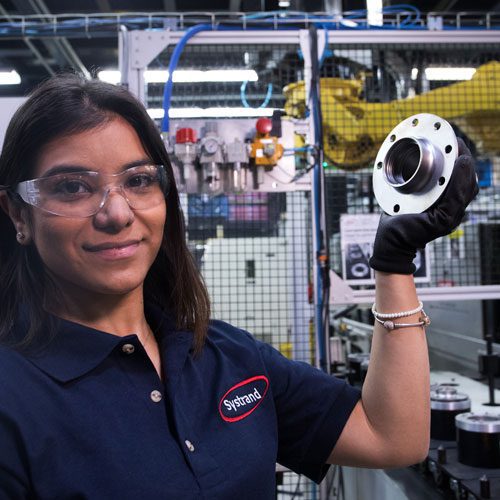
Over 40 Years of Manufacturing Excellence
Founded in 1980, Systrand has produced millions of high-precision shafts, gears, and assemblies for global automotive OEMs. We were among the first precision machine shops to transition to high-volume electric and hybrid vehicle powertrain manufacturing.
1,000,000+ HEV & EV Powertrain Components Deployed
With over one million hybrid and electric vehicle gears actively running in global customer fleets, Systrand has demonstrated field reliability, achieving zero warranty recalls for tooth breakage or cabin noise issues.
World-Class OEM Quality Recognitions
- IATF 16949:2016 Certified: Certified quality management system across all machining, gear honing, grinding, and assembly operations.
- ISO 14001:2015 Certified: Dedicated environmental safety management standards.
- Ford Q1 Preferred Quality Status: Reserved for suppliers maintaining exceptional quality, delivery, and engineering support metrics.
- Recipient of the 21st & 22nd Ford World Excellence Awards: Recognized globally among top tier vendors for operational excellence and quality delivery.
Our engineering facilities in Brownstown, Michigan feature advanced climate-controlled gear measurement laboratories (equipped with Zeiss CMMs, Klingelnberg Gear Inspection Centers, and Taylor Hobson surface profilometers), ensuring all components adhere to strict micro-geometric standards.
Ready to Optimize Your HEV Gear Line for NVH & Precision?
Whether you require early design-for-manufacturability (DFM) input, rapid prototype gear sets, or high-volume serial production with 100% NVH verification, Systrand has the capacity and technical expertise to deliver.