Automotive precision machining and gear manufacturing articles
Transmission gear manufacturing technological insights
EV precision machining and hybrid component manufacturing blog

Automotive Precision Machining & Gear Manufacturing Blog

Industry perspectives, engineering technology updates, and manufacturing best practices from Tier 1 experts.

0%

A quiet gearbox can still hide a costly problem. A faint whine at 1,800 rpm, a vibration near the housing, or a small rise in bearing temperature may signal wear before a failure appears. In 2026, NVH Gear Analysis Testing companies help manufacturers investigate these clues with acoustic measurements, vibration analysis, and gear-mesh diagnostics. The aim is practical: identify noise and vibration sources, verify performance, and guide design or production decisions.

This overview examines providers through relevant experience, technical capabilities, test equipment, and the clarity of their reporting. Useful work may combine controlled laboratory measurements with tests on real gearboxes, under defined loads and speeds. Details matter: sensor placement, operating conditions, calibration, and repeatability can shape the result. A polished report is not enough.

No single company fits every project. Some teams focus on prototype development; others support production troubleshooting or material and durability studies. Comparing their methods can help buyers find a partner suited to their gearbox, timeline, and acceptance criteria. There is room for judgment, too: test results do not always explain every sound. A careful provider should state limitations, not overpromise.
2026 Top NVH Gear Analysis Testing Companies

What NVH Gear Analysis Testing Covers

NVH gear analysis testing examines how gear geometry, loading, speed, and lubrication contribute to noise and vibration. Engineers measure vibration and sound while a gearbox runs through defined speeds and torque levels. A key frequency is gear-mesh frequency: tooth count multiplied by rotational frequency. Sidebands around this frequency can point to modulation from eccentricity, misalignment, or changing load. ISO 1328-1 provides gear accuracy classifications, while ISO 3744 describes sound-power measurement methods. These references help make test results more comparable, though they do not replace application-specific limits.

Useful test data include vibration spectra, sound-pressure or sound-power levels, shaft speed, torque, and temperature. Order tracking helps distinguish gear-related tones from speed-dependent background noise. An industry report should state sensor locations, operating conditions, measurement uncertainty, and any averaging method; without those details, comparing two reported noise values can be misleading. One practical caution: a clean spectrum does not always mean a quiet cabin, because mounting paths and enclosure panels can amplify particular frequencies.

Tips: Record a baseline with the same microphone and accelerometer positions used for later tests. Check calibration and repeat key operating points. Small setup differences matter. Capture brief run-up and coast-down data too; they can reveal resonances that steady-speed measurements miss.

How Gear Noise and Vibration Testing Is Performed

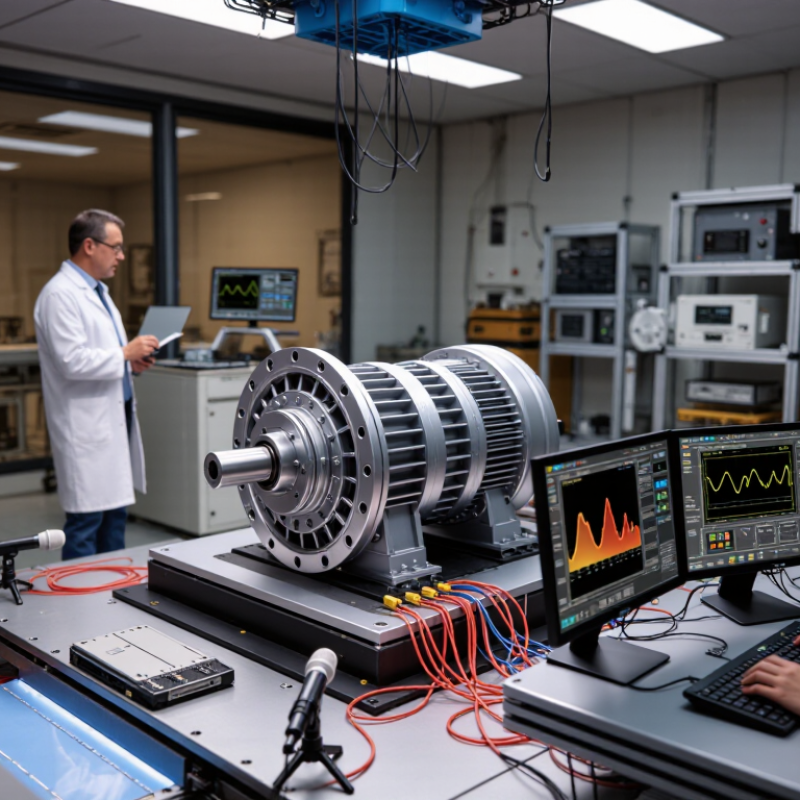
Gear noise and vibration testing starts with a controlled test setup. Engineers mount the gearbox on a rigid fixture. They apply a measured torque and speed through an electric dynamometer. Accelerometers capture housing vibration near the bearings and gear mesh. Microphones record airborne noise at defined distances. Tachometers provide accurate rotational references.

Test software then compares vibration orders with gear-mesh frequencies. It also tracks sidebands, harmonics, and resonance peaks. Engineers repeat each speed and load point several times. This improves repeatability and exposes unstable behavior. Temperature matters too. Lubricant viscosity can change results within minutes.

Tips: Keep sensors firmly attached and cables secured. Check calibration before every test. Record torque, speed, temperature, lubricant condition, and mounting details. Use the same fixture settings for every comparison. A quiet room helps, but it cannot correct poor sensor placement.

The process is not perfectly clean. Background noise may enter the microphone signal. Fixture stiffness can create unexpected peaks. A loose bearing or uneven preload may imitate a gear defect. Experienced analysts review raw time data, not only colorful frequency plots. They inspect run-up and coast-down behavior as well. When results conflict, repeating the test is wiser than forcing a quick diagnosis. Some test plans still overlook thermal stabilization, which can weaken otherwise careful conclusions.

Leading NVH Gear Analysis Testing Companies in 2026

Leading NVH Gear Analysis Testing Companies in 2026 are judged by evidence, not impressive equipment lists. Strong providers combine gear-mesh analysis, vibration testing, acoustic measurements, and operating-load simulation. They examine mesh frequency, sidebands, transmission error, bearing noise, and housing resonance. A practical test may include accelerometers near the gearbox housing, torque sensors on both shafts, and microphones positioned around the enclosure.

Reliable companies use calibrated equipment and traceable measurement methods. They should explain their test limits clearly. Ask whether results can be repeated across speed, torque, oil temperature, and gear backlash changes. Experienced engineers also separate gear noise from motor, bearing, and fixture influences. That separation matters. Otherwise, a clean-looking report may support the wrong design decision. In real development work, small mounting changes can alter a vibration peak. No test plan is flawless. Good teams admit this and document uncertainty.

Tips: Request raw data, test photographs, sensor locations, and calibration records. Check whether the laboratory can reproduce a critical peak under the same load. Prefer reports that connect frequency plots with physical gear behavior, rather than presenting colorful charts alone. A useful provider should also suggest corrective actions, such as profile modification, improved alignment, or housing stiffness changes. Ask for a realistic schedule. Fast results can be helpful, but rushed testing sometimes hides difficult questions.

2026 Top NVH Gear Analysis Testing Companies - Leading NVH Gear Analysis Testing Companies in 2026

This comparison-neutral engineering reference shows the calculated gear-mesh frequency at different operating speeds for a 32-tooth gear. The values are based on the standard relationship: gear-mesh frequency = tooth count × rotational speed ÷ 60. Higher-frequency operating points help NVH testing providers evaluate tonal noise, vibration harmonics, and measurement-system bandwidth.

How to Compare Testing Providers and Their Capabilities

Choosing a gear NVH testing provider means checking how well its test conditions match your real operating range. The IEA’s Global EV Outlook 2024 reports nearly 14 million electric cars were sold in 2023, about 18% of global car sales. Quieter electric drivetrains can make gear whine more noticeable, so a provider should test tonal noise under representative speed, torque, and temperature conditions. Small details matter: a warm gearbox may behave differently from one tested immediately after setup.

Compare dynamometer capacity, fixture stiffness, sensor placement, and measurement repeatability. Ask whether the lab can combine accelerometers, microphones, and order tracking, then link vibration peaks to gear mesh orders. It should document calibration and uncertainty, not just deliver a polished plot. ISO 20816-9 provides guidance for vibration measurement and evaluation of gear units; ISO 3744 covers sound-power measurements. Request sample reports and raw-data access. Check how clearly they explain deviations and reruns. A neat dashboard is useful, but it can hide a weak test setup. No single lab metric tells the whole story.

2026 Top NVH Gear Analysis Testing Companies - How to Compare Testing Providers and Their Capabilities

Comparison framework for common provider types, rather than a ranking of named companies. Capabilities vary by facility and should be verified directly before engagement.

Provider type Typical gear NVH capabilities Common test setup Useful deliverables Best suited for Questions to verify
Independent NVH laboratory Noise and vibration measurements; order and frequency analysis; comparison of gear designs or operating conditions. Microphones, accelerometers, tachometer or encoder signals, and a controlled test rig or customer-supplied assembly. Time histories, spectra, order plots, test conditions, measurement notes, and comparative findings. Root-cause investigations, design comparisons, and independent measurement work. Can the lab test the required torque, speed, temperature, and mounting conditions? What calibration and uncertainty information is supplied?
Gear or transmission test facility NVH evaluation in a drivetrain context, potentially including loaded operation, multiple speeds, and assessment of gear mesh-related behavior. Gearbox or transmission dynamometer with controlled speed and load; sensors selected for the test objective. Operating-point results, vibration and sound data, test-cell configuration, and observations under load. Transmission-level validation and testing where load and operating conditions matter. What torque and speed envelope is available? Can the rig reproduce the application’s boundary conditions and duty cycle?
Automotive or mobility test center System-level acoustic and vibration testing, with scope that may include the gearbox, motor, mounts, and surrounding structure. Component, subsystem, or vehicle test environment; measurement methods depend on the test plan. System-level recordings, vibration results, operating-condition logs, and correlation observations. Evaluating gear noise in the context of a larger vehicle or electric-drive system. Can the provider isolate gear-related contributions from motor, bearing, tire, or structural noise?
Acoustics-focused consultancy or lab Sound measurement and analysis, acoustic diagnostics, and investigation of tonal or broadband noise characteristics. Microphone-based measurements in a test room or other specified acoustic environment, often combined with vibration or rotational reference signals. Sound-pressure data, spectra, tonal analysis, measurement setup details, and diagnostic interpretation. Noise characterization, acoustic troubleshooting, and sound-quality assessments. Is the environment suitable for the required measurement? Are microphone positions, background noise, and operating conditions documented?
General mechanical testing laboratory May provide vibration measurements and mechanical testing; dedicated gear NVH rigs and specialist gear diagnostics are not universal. Test equipment configured to the project, which may require customer fixtures, sensors, or specialist analysis support. Measurement records and reports defined by the agreed scope. Projects with straightforward measurement needs or an established customer test method. Has the lab previously tested comparable gears or gearboxes? Which parts of the analysis are performed in-house?

Key comparison criteria

Criterion What to compare
Operating envelopeAvailable speed, torque, temperature, and test duration against the application requirements.
Measurement planSensor types and locations, rotational reference, test environment, operating points, and repeatability approach.
Analysis depthWhether the scope includes time, frequency, and order-domain analysis, plus interpretation tied to gear operating conditions.
Data and reportingRaw-data access, file formats, documented test conditions, calibration records, uncertainty information, and report turnaround.
Quality and relevanceRelevant quality-system accreditation, demonstrated experience with comparable assemblies, confidentiality terms, and ability to reproduce the test.

How to Choose an NVH Gear Testing Partner

Choosing an NVH gear testing partner starts with the test plan, not the equipment list. Ask how the lab separates gear-mesh noise from bearing, motor, and fixture effects. A credible team should explain its sensor locations, speed and torque range, calibration records, and repeatability checks. Request a sample report with order-tracking plots, sound-pressure data, and clear notes on uncertainty. Can the setup reproduce your actual load cycle? Small fixture changes can shift a resonance peak.

MarketsandMarkets’ 2023 automotive NVH market report estimated the market at about USD 12.7 billion and projected continued growth through 2030. That forecast is not a measure of laboratory quality, but it shows why testing capability matters across vehicle programs. Compare partners on relevant gear experience, data traceability, test-cell capacity, and how quickly engineers can investigate an unexpected tonal peak. A polished dashboard is useful. It is not proof of sound measurement practice.

Tips: Share gear geometry, lubrication, operating temperatures, and target duty cycles before requesting a quote. Ask for a short pilot test using a representative assembly. Check whether the lab documents microphone position and background noise. If a supplier promises a single “quiet” result without conditions, probe further; honestly, test outcomes can be messier than a sales slide suggests.

FAQS

What is measured during gear noise and vibration testing?

Accelerometers measure gearbox vibration near bearings and gear mesh. Microphones record airborne noise at defined distances. Torque, speed, and temperature are recorded too.

How do engineers identify gear-related noise?

Software compares vibration orders with gear-mesh frequencies. Analysts also inspect sidebands, harmonics, and resonance peaks. A bright chart alone is not enough.

Why repeat each speed and load point?

Repeated runs improve consistency and can reveal unstable behavior. They also help engineers distinguish real patterns from test variation.

How can temperature affect test results?

Lubricant viscosity can change within minutes as temperature shifts. Without thermal stabilization, comparisons may be weaker than they appear.

What can create misleading vibration peaks?

Fixture stiffness, loose bearings, or uneven preload can imitate gear defects. A loose cable can also spoil a measurement.

What should a testing partner explain before a test?

Ask about sensor locations, calibration, speed and torque ranges, and repeatability checks. The team should also explain how it separates gear noise from bearing, motor, and fixture effects.

What details should be shared before requesting a quote?

Provide gear geometry, lubrication, operating temperatures, and target duty cycles. These details help the lab plan a representative test.

What should a useful test report include?

Look for order-tracking plots, sound-pressure data, and clear notes about uncertainty. Microphone position and background noise should be documented.

Why request a short pilot test?

A pilot can show whether the setup reproduces your actual load cycle. Small fixture changes may shift a resonance peak. Results can still be messy.

Conclusion

NVH Gear Analysis Testing evaluates the noise, vibration, and harshness behavior of gears, gearboxes, and related drivetrain systems. It covers key performance indicators such as tonal noise, transmission error, vibration levels, acoustic emissions, resonance behavior, and operating durability. Testing may be performed under controlled loads, speeds, temperatures, and lubrication conditions using sensors, microphones, torque meters, accelerometers, and advanced data acquisition systems. The results help identify gear meshing issues, alignment errors, structural weaknesses, and sources of unwanted sound or vibration.

In 2026, leading testing companies are expected to combine precise laboratory measurement, realistic operating simulations, efficient reporting, and strong engineering analysis. When comparing providers, manufacturers should review equipment capability, test standards, measurement accuracy, software tools, facility capacity, turnaround time, and technical expertise. The best NVH gear testing partner should understand the product’s application, provide clear and actionable findings, protect confidential information, and support development from early design validation through final quality verification.

Evelyn

Evelyn

Evelyn is a dedicated marketing professional with a deep understanding of the company’s offerings and industry landscape. With a keen eye for detail and a passion for strategic communication, she expertly crafts engaging blog articles that not only highlight the latest developments in our products......