Automotive precision machining and gear manufacturing articles
Transmission gear manufacturing technological insights
EV precision machining and hybrid component manufacturing blog

Automotive Precision Machining & Gear Manufacturing Blog

Industry perspectives, engineering technology updates, and manufacturing best practices from Tier 1 experts.

0%

In 2026, Gear Grinding and Polishing machines are becoming more precise, connected, and application-specific. They shape the final surface that customers rarely see but always measure. A small thermal mark, uneven flank, or leftover burr can weaken an otherwise excellent gear.

Dr. Hermann J. Stadtfeld, a respected gear technology specialist, has stated, “Gear noise is a system problem, not a gear problem.” This principle remains important when comparing machine types. Generating grinders suit high-volume production, while profile grinders support complex tooth forms and correction strategies. Internal gear grinders address compact assemblies and demanding transmission designs. Polishing machines then reduce roughness, improve sliding behavior, and remove microscopic surface irregularities. Some systems combine grinding, honing, and polishing in one production cell.

Yet, no machine is universally best. That sounds obvious, but many purchasing guides still simplify the decision. Engineers must examine gear size, material hardness, module, helix angle, production volume, and required flank accuracy. Coolant control matters too. A bright, smooth tooth surface may hide grinding burn or unstable geometry. Reliable selection requires inspection data, operator experience, and repeatable process trials.

This guide reviews the leading 2026 Top Gear Grinding and Polishing Machine Types. It compares operating principles, suitable applications, automation features, finishing performance, maintenance demands, and investment considerations. The discussion also recognizes practical weaknesses, including setup time, operator learning curves, and inconsistent results from poorly controlled polishing media. Precision is achievable, but it is not automatic.
2026 Top Gear Grinding and Polishing Machine Types

What Are Gear Grinding and Polishing Machines?

Gear Grinding and Polishing Machines: What They Do

Gear grinding and polishing machines finish tooth surfaces after cutting and heat treatment. Grinding removes hardened material with an abrasive wheel. Polishing, honing, or superfinishing reduces microscopic peaks.

The result is quieter operation, better contact, and improved resistance to fatigue.

Typical machines include generating grinders, profile grinders, internal grinders, gear honing machines, and polishing systems.

These machines use controlled motion, coolant, dressing tools, and in-process measurement.

A generating grinder moves the workpiece and abrasive wheel in a synchronized pattern.

A profile grinder follows the exact tooth shape. Honing uses a meshing tool to correct small surface errors. It feels almost like tuning a musical instrument.

According to Grand View Research, the global grinding machinery market was valued at approximately USD 5.8 billion in 2023. MarketsandMarkets also identifies automation and precision manufacturing as major growth drivers in gear production.

These figures cover wider grinding equipment, not gear machines alone, so interpretation requires care. That distinction matters.

In practical workshops, operators check tooth contact, runout, surface roughness, and thermal damage.

A bright tooth surface is not automatically a good surface.

Excessive polishing can remove useful geometry or create unwanted lead changes. I have found the boundary between grinding and polishing is not always neat.

Process selection depends on hardness, module, material, accuracy grade, and production volume.

Measurement remains essential.

How Gear Grinding Machines Work

2026 Top Gear Grinding and Polishing Machine Types

How Gear Grinding Machines Work

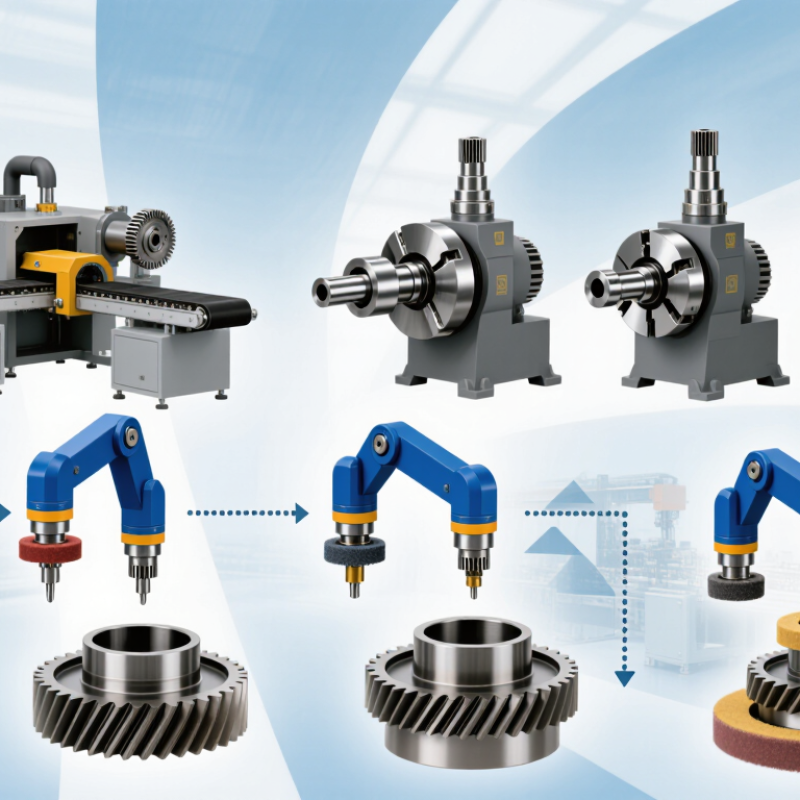
Gear grinding machines remove tiny amounts of hardened material from gear teeth. The process usually follows heat treatment, when the gear has gained strength but may have slight distortion. A rotating abrasive wheel contacts each tooth with controlled pressure. The machine synchronizes wheel speed, gear rotation, and tooth movement. This coordination creates the correct involute profile and tooth spacing.

Two common methods are form grinding and generating grinding. Form grinding uses a wheel shaped like the required tooth space. Generating grinding uses a continuous motion that resembles gear meshing. CNC controls guide these movements with extreme precision. Coolant flows across the contact zone, carrying away heat and metal particles. Without steady cooling, surface burns or unwanted hardness changes may appear.

Wheel dressing keeps the abrasive surface sharp and accurate. Operators also check runout, vibration, coolant condition, and workholding alignment. A small setup error can repeat across every tooth. That is expensive. Inspection often includes a gear measuring machine, where technicians examine profile, lead, pitch, and surface roughness. Results should be recorded and compared with drawing requirements.

The process is highly precise, but never completely automatic. Tool wear changes cutting behavior gradually. Experienced technicians notice unusual sound, heat, or marks before measurements confirm a problem. Some assumptions still need questioning, especially when production speed increases. A polished surface is not enough; the gear must also mesh correctly under load.

2026 Top Gear Grinding and Polishing Machine Types — How Gear Grinding Machines Work

Gear grinding machines remove a controlled amount of hardened material with an abrasive wheel to correct tooth geometry, reduce noise, and improve surface finish. Generating and profile grinding are commonly used for precision tooth finishing, while honing and lapping provide additional polishing and finishing capabilities.

Typical surface roughness ranges are shown in micrometres (Ra). Actual results depend on gear material, heat treatment, abrasive type, machine rigidity, dressing parameters, coolant, and process settings. Lower Ra values indicate a smoother finished surface.

How Gear Polishing Machines Improve Surface Finish

Gear polishing machines improve surface finish by removing fine burrs, grinding marks, and small surface irregularities after cutting or heat treatment. In production, the right process depends on tooth profile, material hardness, and the required roughness value. Gear honing machines create controlled contact between the tool and gear teeth, while abrasive brushing systems reach edges and narrow root areas. Each method leaves a different texture.

A skilled operator checks the gear before polishing. Oil residue, uneven tooth geometry, or excessive stock can reduce consistency. I have seen a bright surface hide a deeper profile error. Appearance alone is not enough. Measurement matters. Roughness testers, profile gauges, and inspection under angled light provide stronger evidence. Short polishing cycles usually protect tooth geometry, but they may not remove every grinding mark.

The first trial is rarely perfect. Tool pressure, abrasive size, speed, and coolant flow often need adjustment. Too much pressure can round tooth edges and generate heat. Too little pressure wastes cycle time. Clean filtration also matters because trapped particles can scratch the finished surface. Reliable results come from recorded settings, regular tool checks, and sample inspections throughout the run. Even experienced teams should review the process when material batches or gear sizes change.

Main Types of Gear Grinding and Polishing Machines

Gear grinding and polishing machines are selected by tooth geometry, production volume, and required surface quality. Generating grinding machines suit high-volume helical and spur gears, using continuous contact between the tool and gear. Profile grinding machines follow the programmed tooth form, making them useful for prototypes, large gears, and corrective work. Internal gear grinders handle ring gears and compact transmission components. Each type solves a different accuracy problem.

According to Grand View Research’s 2024 machinery analysis, automotive applications held more than 40% of global gear-manufacturing equipment demand. That pressure favors automated generating grinders with in-process dressing and measurement. CBN grinding wheels reduce thermal damage when operators control coolant flow carefully. Small mistakes still matter. A blocked nozzle can create uneven tooth temperatures within minutes.

Polishing equipment includes gear honing, lapping, and superfinishing machines. Honing removes fine grinding marks and lowers noise in precision transmissions. Lapping improves contact patterns, but it can reduce intentional profile corrections if used too aggressively. The International Organization for Standardization identifies ISO 1328 as a key reference for gear accuracy classification. In practice, many workshops target ISO Grade 6 or better for demanding powertrain parts. That target is not universal; material, module, heat treatment, and measurement uncertainty must guide the final choice.

How to Select the Right Machine for Gear Production

Choosing a gear grinding or polishing machine starts with the gear, not the catalogue. Define module, pitch diameter, tooth width, material, hardness, batch size, and required accuracy. Generating grinders suit high-volume helical and spur gears. Profile grinders offer flexible control for unusual tooth forms. Honing and lapping machines improve noise, contact pattern, and surface finish after heat treatment.

ISO 1328-1 remains a useful reference for gear accuracy classes. However, tolerance alone can mislead. A machine may meet the grade but fail to control thermal drift during a long shift. Check spindle stiffness, dressing accuracy, coolant filtration, probing, and inspection integration. Deloitte’s 2024 Smart Manufacturing and Operations Survey found that 86% of manufacturers expect smart manufacturing to become a major competitiveness driver within five years. That supports connected machines, but automation should solve a measured bottleneck, not decorate the factory.

Tips: Compare total cost per finished gear, including tooling, dressing wheels, coolant, energy, inspection, and operator time. Request sample trials using your steel and heat-treatment condition. Measure cycle time and tooth-flank results after several hours, not one impressive part. I would also challenge the supplier’s best-case figures. They are often too clean. Review service response, software training, and spare-part availability before approval. A cheaper machine can become expensive when calibration waits for weeks. For smaller batches, flexible fixturing may matter more than peak production speed. For electric-vehicle gears, prioritize low noise, stable finishing, and traceable inspection data.

2026 Top Gear Grinding and Polishing Machine Types - How to Select the Right Machine for Gear Production

Typical industry ranges are provided for preliminary machine selection. Actual capacity and accuracy depend on workpiece geometry, tooling, material, heat treatment, coolant, and process parameters.
Machine Type Primary Process Compatible Gear Forms Typical Workpiece Range Typical Achievable Quality Typical Surface Finish Best Production Stage Main Advantages Key Limitations Recommended Selection Criteria
Generating Gear Grinder Continuous generating grinding with a threaded grinding wheel External spur and helical gears Approx. module 1–8; outside diameter up to about 800 mm, depending on configuration Commonly ISO 6–8 for hardened gears after suitable process control Typically Ra 0.2–0.6 µm High-volume finishing after heat treatment High throughput, consistent tooth spacing, efficient for repeat production Less suitable for internal gears, special tooth profiles, and very large gears Choose when production volume is high and the gear family has standardized external teeth
Profile Gear Grinder Tooth-by-tooth profile grinding using a formed or dressable wheel External gears, internal gears, splines, and custom tooth forms Approx. module 0.5–12; outside diameter commonly 20–1,000 mm Commonly ISO 4–7 with suitable machine, dressing, and measurement control Typically Ra 0.15–0.5 µm Precision, low-volume, prototype, and difficult-profile production High flexibility and excellent profile, lead, and crowning control Lower productivity than generating grinding for large batches; higher programming requirements Choose when geometry flexibility and tight tooth-form tolerances are more important than cycle time
Bevel Gear Grinder Precision grinding of curved or straight bevel gear tooth surfaces Spiral bevel, hypoid, and selected straight bevel gears Commonly 50–1,200 mm pitch diameter, depending on machine size and gear set Typically ISO 5–8 for finished automotive and industrial bevel gear sets Typically Ra 0.2–0.8 µm Post-heat-treatment finishing of high-load gear pairs Improves contact pattern, noise behavior, load capacity, and tooth accuracy Specialized tooling, complex setup, and higher process sensitivity Choose based on gear-set geometry, contact-pattern requirements, and workholding capacity
Gear Honing Machine Abrasive honing with a gear-shaped honing ring or tool External spur and helical gears, especially automotive transmission gears Approx. module 1–5; outside diameter commonly up to 400 mm Commonly ISO 6–8; often used for noise and surface improvement rather than major stock removal Typically Ra 0.15–0.4 µm Fine finishing after grinding or hard shaving Low noise, cross-hatch texture, modest stock removal, and good repeatability Limited correction capability; requires compatible tooth geometry and controlled alignment Choose when noise reduction and smooth running are priorities after a preceding hard-finishing operation
Gear Lapping Machine Controlled abrasive lapping between a gear pair or gear and lapping tool Bevel, hypoid, and selected cylindrical gear pairs Commonly 50–1,000 mm pitch diameter, depending on application Usually ISO 7–9; primarily used to improve contact and running behavior Typically Ra 0.3–1.0 µm Final matching and contact-pattern correction Corrects localized contact issues, improves quietness, and matches gear pairs Low material-removal rate and limited ability to correct major geometric errors Choose when pair matching and contact pattern are more important than high stock-removal efficiency
Gear Polishing Machine Abrasive belt, brush, wheel, or flexible-tool polishing External gears, selected internal gears, splines, and precision components Typically module 0.5–10; diameter range varies widely by fixture and tool design Generally used for edge and surface improvement rather than primary dimensional correction Approximately Ra 0.1–0.5 µm, depending on abrasive and preceding finish Cosmetic, functional, or ultra-fine finishing after grinding or honing Improves appearance, removes light marks, and can reduce friction-related surface irregularities Limited control of tooth profile and lead; excessive polishing can alter edges Choose according to required edge condition, surface target, allowable stock removal, and automation level
Gear Deburring and Edge-Rounding Machine Mechanical brushing, chamfering, milling, or abrasive edge treatment External gears, internal gears, splines, and transmission components Commonly module 0.5–8; diameter often up to 600 mm Dimensional gear accuracy is largely inherited from the preceding process Edge condition is the primary output; surface finish varies by tool Intermediate or final edge treatment after hobbing, shaping, or grinding Removes burrs, protects assembly parts, and reduces stress concentrations at tooth edges Does not replace precision grinding or honing for tooth-form correction Choose based on burr size, required chamfer or radius, cycle time, and part orientation
Cylindrical Superfinishing Machine Oscillating abrasive-film or stone superfinishing Hardened gear flanks, journals, bearing seats, and selected splines Typically module 1–8; component diameter commonly 20–500 mm Used after precision grinding when dimensional correction requirements are small Typically Ra 0.05–0.25 µm Ultra-fine finishing for friction, wear, and noise-sensitive applications Very low roughness, improved tribological behavior, and controlled surface texture Very low stock-removal rate; cannot correct substantial profile, lead, or pitch errors Choose when the process specification emphasizes friction, wear life, and a very low roughness value
Universal CNC Gear Finishing Cell Configurable grinding, honing, deburring, or polishing with automated handling Mixed families of external gears, splines, and selected internal gears Typical modular range 0.5–8; capacity depends on interchangeable tooling and axes Depends on the installed finishing process; commonly ISO 5–8 for grinding-based cells Approximately Ra 0.15–0.8 µm, depending on operation Flexible, automated production with inspection and process monitoring Reduces handling, supports traceability, and adapts to multiple part numbers Higher initial investment, greater controls complexity, and longer integration time Choose when product variety, labor reduction, data collection, and future scalability justify automation

FAQS

What do gear grinding and polishing machines do?

They finish gear teeth after cutting and heat treatment. Grinding removes hardened material. Polishing reduces tiny surface peaks. The goal is quieter operation and better tooth contact.

How does a gear grinding machine work?

An abrasive wheel touches each tooth with controlled pressure. The wheel and gear rotate together. CNC controls maintain accurate tooth shape and spacing.Precision matters.

What is the difference between form grinding and generating grinding?

Form grinding uses a wheel shaped like the required tooth space. Generating grinding imitates the rolling action of meshing gears. Form grinding suits corrections and unusual shapes. Generating grinding often supports repeated production.

Which machine types are commonly used?

Generating grinders handle many spur and helical gears. Profile grinders suit prototypes, large gears, and corrective work. Internal grinders finish ring gears. Honing and superfinishing machines reduce fine marks.

Why is coolant important during grinding?

Coolant carries away heat and metal particles. Poor flow can cause burns or hardness changes. A blocked nozzle may create uneven tooth temperatures quickly.Small errors spread.

What inspections are needed after grinding?

Technicians check profile, lead, pitch, runout, contact, and surface roughness. They may use a gear measuring machine. Results should match the drawing requirements. A bright tooth surface alone proves very little.

How should a workshop choose a machine?

Selection depends on tooth shape, hardness, module, accuracy, and production volume. Large gears may need profile grinding. High-volume work may favor continuous generating grinding. Measurement capability should influence the decision too.

Can polishing fix every gear problem?

No. Honing can reduce grinding marks and operating noise. Lapping can improve contact patterns. Excessive polishing may remove useful geometry or alter lead corrections. This boundary is easy to underestimate.

Is the process completely automatic?

Not really. Tool wear gradually changes cutting behavior. Operators still monitor vibration, sound, heat, coolant, and alignment. Experience helps, but assumptions need regular checking. Automation cannot replace careful measurement.

Conclusion

Gear Grinding and Polishing machines are essential for producing accurate, durable, and smooth gears used in many mechanical systems. Grinding machines remove small amounts of material with controlled precision, correcting tooth geometry, reducing errors, and achieving the required dimensional accuracy. Depending on the production process, they may use different abrasive methods, workpiece arrangements, and automation levels to support both individual components and high-volume manufacturing.

Polishing machines focus on improving the final surface finish after machining or grinding. By reducing fine marks, roughness, and surface irregularities, they help lower friction, noise, and wear during operation. Common machine types include gear grinding systems, profile grinding machines, generating grinders, honing equipment, lapping machines, and finishing polishers. Selecting the right solution requires evaluating gear size, tooth design, material, accuracy requirements, surface-finish targets, production volume, automation needs, maintenance demands, and overall operating cost. A balanced choice can improve consistency, productivity, and long-term gear performance.

Alexander

Alexander

Alexander is a dedicated marketing professional with a deep expertise in our company's offerings. With a keen understanding of market dynamics and consumer behavior, he plays a crucial role in shaping our branding strategies and enhancing customer engagement. As a prolific writer, Alexander......